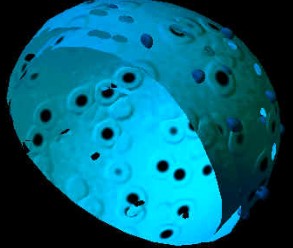
Nucleus membrane
The nuclear membrane consists of an inner and outer membrane with a perinuclear space between them. The outer membrane has regions that are continuous with the endoplasmic reticulum and is studded with ribosomes at the 'outside' surface. It is similar to the membrane of the rough endoplasmic reticulum (ER) and is thought to derive from it. In some cells filament extend from the outer membrane into the cell's cytoplasm, possibly anchoring the nucleus in the cell. The perinuclear space is about 20 - 40 nm wide and is filled with fluid. It is believed that this fluid compartment is continuous with the ER and Golgi cisternae. The nuclear envelope has numerous pores, typically 3000 - 4000 pores. The pores represent points of fusion between the inner and the outer membranes. It is believed that the pores are the transportation gateways for enzymes and proteins into the nucleus, RNA molecules and partially assembled ribosomes out of the nucleus.